If you run a small business, you have probably wondered whether pamphlets, referrals and word of mouth are still enough, or whether you should also be on Google, Facebook and Instagram. And once you decide to go online, the next question is where to start without wasting money.
This guide explains digital marketing for small business in simple language: what it is, which channels matter, the mistakes I see business owners make, and how to begin. It also explains why you do not have to give up traditional marketing to do it.
Quick answer: Digital marketing means using online platforms such as Google, social media and your website to promote your business, build your brand and sell your products or services. For a small business, it works best when you choose channels based on where your customers search and spend time, not by copying every platform. It also works best alongside traditional marketing, not instead of it.
How Has Marketing Changed for Small Businesses?
Customers have changed how they find and check businesses, so marketing has had to change with them.
Earlier, many small businesses grew through existing customers and local promotion:
- Referrals and word of mouth
- Newspaper advertisements
- Pamphlets and flyers
- Banners and signboards
- Local events, stalls and exhibitions
- Door-to-door promotion
These methods still work, especially for businesses that depend on their local area. What has changed is customer behaviour.
Today, someone who hears about your business may first search for it on Google. They may look at your website, Google Business Profile, social media pages, photographs and reviews before they call or visit.
Many business owners did not move to digital marketing because they wanted to. They moved because their customers had already started checking businesses online, and newer businesses with a stronger online presence began getting more visibility and enquiries.
There is one more practical difference. With traditional advertising, it is harder to control who sees your message and to measure what it achieved. Online platforms give you more options to target an audience, track results and improve. That does not make digital marketing automatically cheaper or guarantee results. It simply gives you more to learn from.
What Is Digital Marketing?
Digital marketing is how a business uses online platforms to be found, build trust and get enquiries.
When I explain it to business owners, I describe it as using online platforms to promote, build the brand and sell a product or service. The part many beginners miss is that different platforms do different jobs. The biggest difference is between search and social media.
Search fulfils existing demand
When someone searches Google for “best catering service in Chennai” or “digital marketing coach in Chennai”, they already have a need. They are looking for a business that can solve it.
SEO, Google Ads and Google Business Profile help your business appear at that moment.
Social media creates demand
Someone scrolling through Instagram or Facebook is usually not searching for your service. But useful content, a good demonstration, a customer story or a relevant ad can create interest, and that interest can later turn into an enquiry.
For example, a person may not be looking for a bridal makeup artist today. After seeing a beautiful bridal transformation, they may remember that artist when the wedding date is fixed.
In my training, I call search a demand-fulfilment platform and social media a demand-creation platform. There can be overlap, but this difference helps beginners decide what each channel is for.
The Digital Marketing Channels Every Business Owner Should Know
You do not need to use every channel. Here is the map, so you know what each one is for.
- SEO – Helps your website and content appear in unpaid Google results when people search for what you offer. It takes time, but it builds long-term visibility. Read more: What Is SEO? A Simple Guide for Business Owners.
- Google Ads – Paid ads for selected search terms and locations. Useful when you want to appear in front of people who are already searching.
- Google Business Profile – Your business listing on Google Search and Maps, with address, phone number, hours, photos and reviews. Very important for local businesses.
- Social Media Marketing – Regular posting on Facebook and Instagram to build awareness, show your work and stay in front of potential customers. Read more: How Social Media Marketing Can Help Grow Your Business.
- YouTube and Video Marketing – Videos that explain your product or service, answer customer questions and build familiarity. Reels fall into this group too.
- Facebook & Instagram Ads – Paid reach to selected audiences based on location, interests and behaviour. Decide the objective before you spend.
- Website and Landing Pages – The place where customers check your business in detail. It supports every other channel, because ads, posts and searches usually lead people here.
- WhatsApp, Email and Other Communication Channels – Used to answer questions, follow up with enquiries and stay in touch with customers.
You do not need to be everywhere. You need to be where your customers are and where you can consistently manage your marketing.
How Does Digital Marketing Turn Visibility into Customers?
Digital marketing works as a journey, not as a single post or advertisement.
Search → Understand → Build Trust → Enquire → Follow Up → Convert
- Search – People look for a solution on Google, social media or through local references.
- Understand – They check your website, services and product details.
- Build Trust – They look at reviews, ratings and your past work.
- Enquire – They call, message you on WhatsApp or fill in an enquiry form.
- Follow Up – They ask questions, discuss requirements, get quotations and compare options.
- Convert – They decide to buy from you.

One of the biggest misunderstandings I see among business owners is expecting a single post to bring an immediate sale. Customers usually go through several of these steps before they contact you.
Before you spend money on marketing, ask yourself six questions: how will the customer discover me, what information will they need, why will they trust me, how will they contact me, how will I follow up, and how will I convert the enquiry into a customer?
Visibility is only the beginning. Digital marketing alone does not guarantee sales, because your product, pricing, customer experience and follow-up also decide the final result.
Common Digital Marketing Mistakes I Have Observed
After working with and training business owners, these are the five mistakes I see most often.
1. Building a website for appearance instead of business purpose
Some businesses choose a website because it looks attractive or because it is cheap. A website should help customers understand your business, build confidence and take the next step.
2. Posting randomly without a content strategy
Many pages list product features without explaining the benefit to the customer. A good post answers one question: why should the customer care? Posting only because “we need to post something today” is not a strategy.
3. Not checking what is actually happening
Many of my students depend on agencies for their posts and reels. Agencies often charge roughly ₹6,000 to ₹15,000 a month for about two posts and one reel a week. The content looks good, so the business owner assumes it is working. But many cannot say how many people saw it, what the cost per lead is, or even where to check the insights. Look at:
- Views and reach
- Profile visits
- Follower growth
- Enquiries and leads
Views are one signal. They do not tell the full business story.
4. Spending money without a clear objective
Running an ad because competitors are running ads is not a strategy. Decide whether you want awareness, website visits, WhatsApp enquiries or sales, and how you will measure it.
For example, spending ₹500 per day for 10 days is a ₹5,000 investment. You should then look at what that money produced for the business. ROAS (Return on Ad Spend) is one useful measure: the revenue generated from ads divided by the amount spent on them.
5. Expecting Google visibility just because you have a website
Having a website does not mean Google will show it prominently. Visibility depends on relevance, content, technical quality, local signals and competition. The same applies to a well-known offline business, because being known in your area does not automatically mean being visible online.
Does Every Business Need the Same Digital Marketing Strategy?
No. The right channels depend on your customers, where they look for information and how they decide to buy.
Before choosing channels, ask three questions:
- Who are my customers?
- Where do they spend time or search for information?
- How do they make their buying decision?
Three examples:
- Bridal makeup artist – a highly visual business, so Instagram works well for showing transformations, makeup styles and results.
- Real estate – Facebook can create awareness, while Google can reach people actively searching for properties.
- Catering – Facebook and Instagram suit food that looks good and a business that depends on location.
Your own comfort with content matters too. If you speak naturally on camera, video can be a powerful tool. But do not try to sound like a television news reader. Talk to your customer, answer the questions they usually ask and use your own style.
Organic posting may not give enough reach on its own. Depending on your objective and budget, paid advertising can become part of the plan.
Also, do not judge results after one day. Some businesses have a short buying cycle, while others take weeks or months before a customer decides. Your measuring period should match your business.
How Should a Small Business Start Digital Marketing?
Start with the business, not the platform. If you have never done digital marketing, follow these six steps.
- Understand your customer and competition. Know who your customers are, who your competitors are, what problem you solve, what people might search for and why they should choose you.
- Check your existing online presence. Look at your website, Google Business Profile, Facebook, Instagram, YouTube and reviews. Many businesses already have pages created by a friend, an agency or after a webinar. I do not tell them everything is wrong. We look at what exists and decide what is not yet enough and can be improved.
- Build trust through content. Do not copy a viral Reel. Show your products or services, customer benefits, reviews, previous work and the experience behind your business. A post that answers a genuine customer question is more useful than one with thousands of views and no enquiries.
- Build the right website. Study websites of good businesses in your industry first. Show your developer examples instead of only saying “I need a website”, and compare options. Do not choose a website only because it is the cheapest.
- Become visible where customers search. Depending on your business, this could be Google Business Profile, SEO, Google Ads or social media. You do not need all of them at once.
- Start small and improve. Choose the channels that suit your customers and that you can manage consistently. Test, measure the results and improve. Digital marketing is an ongoing process, not something you do for ten days and then stop.
Does Traditional Marketing Still Have a Place?
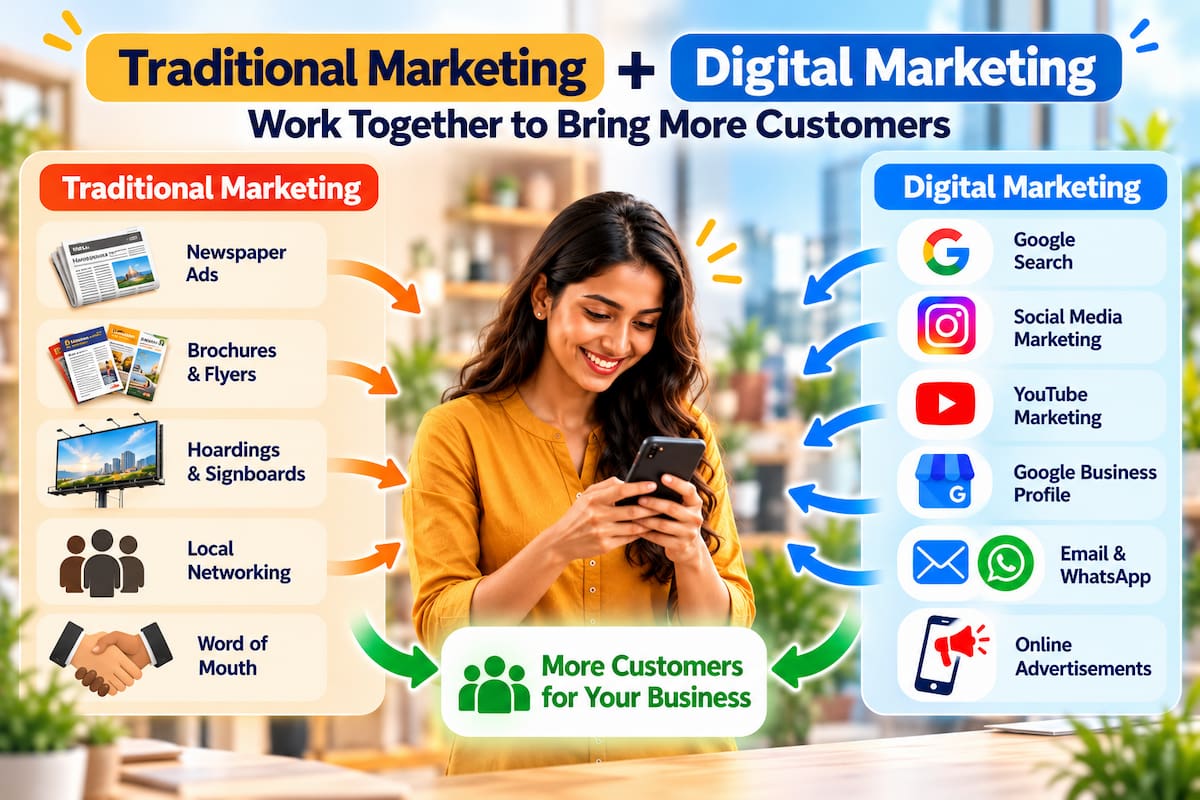
Yes. Digital marketing adds to traditional marketing. It does not replace it.
For many local businesses, physical presence and local trust still matter. Think of a grocery store, a supermarket or a spa. Online marketing can help more people discover the business, but customers still have to visit that location. Local events, referrals, pamphlets, posters, banners, stalls and exhibitions can all help people in the area come through the door.
I have seen this myself. Earlier in my career, I worked in car showroom sales. The showroom had a website and a social media presence, but we also ran strong local campaigns:
- Door-to-door visits by our sales executives
- Paper insert campaigns
- Displays in different bank branches in our area
Once a month we ran a bigger campaign. We arranged a display of two or three cars at a local marriage hall (mahal or kalyana mandapam), and distributed notices in and around that area to bring people to the exhibition. We also offered spot discounts for bookings made there.
That experience showed me that offline and online marketing do not have to compete. They can support each other.
A simple example:
Referral or pamphlet → Customer searches online → Finds your website, Google Business Profile and reviews → Contacts you
The traditional channel creates awareness. Your online presence gives the customer the proof and confidence to take the next step.
Traditional or digital marketing: which is better?
That is not the best question. The better question is which combination suits this business and its customers. The answer depends on your:
- Business and customers
- Location
- Buying behaviour
- Marketing objective
- Budget
- Available time and resources
Final Thoughts
From the above, you now have a clear picture of what digital marketing means for a small business. Here is what to remember:
- Customer behaviour has changed, so businesses now have many ways to reach people: search, social media, websites, ads and messaging.
- Search and social media do different jobs.
- Not every business needs the same strategy.
- Posting or spending money alone does not guarantee results.
You also do not have to stop traditional marketing because you start digital marketing. Traditional methods can still be very valuable, especially for local businesses. The right approach is to find the right mix of traditional and digital marketing based on your business, customers, location, objectives and budget.
The approach I teach business owners is simple:
Understand your customer → Choose the right channels → Build trust → Generate enquiries → Measure → Improve
Digital marketing is not about being present everywhere. It is about being present in the right places, with the right message, for the right customers, and doing it consistently.
If you are not sure which digital marketing channels are right for your business, Digital Success Tamil offers one-to-one Business Growth Coaching to help you understand what to do, why to do it and how to implement it step by step.
Learn more