You started using Facebook or Instagram because it was free. You created a business profile, posted photos and offers, made a few Reels, and maybe even started posting regularly.
But after some time, you may have asked yourself:
"I am posting regularly. So why am I still not getting enough enquiries?"
This is a very common problem among small businesses. The problem is not that social media does not work. The real issue is that using social media and doing social media marketing are two different things.
Quick Answer: Social media marketing for a small business helps it get discovered, build trust, show its products or services, start conversations and generate enquiries. It works when you combine useful content with paid ads, have a clear business objective for a specific audience, and track the results, not just stay active.
Let's look at the practical ways it can help your business.
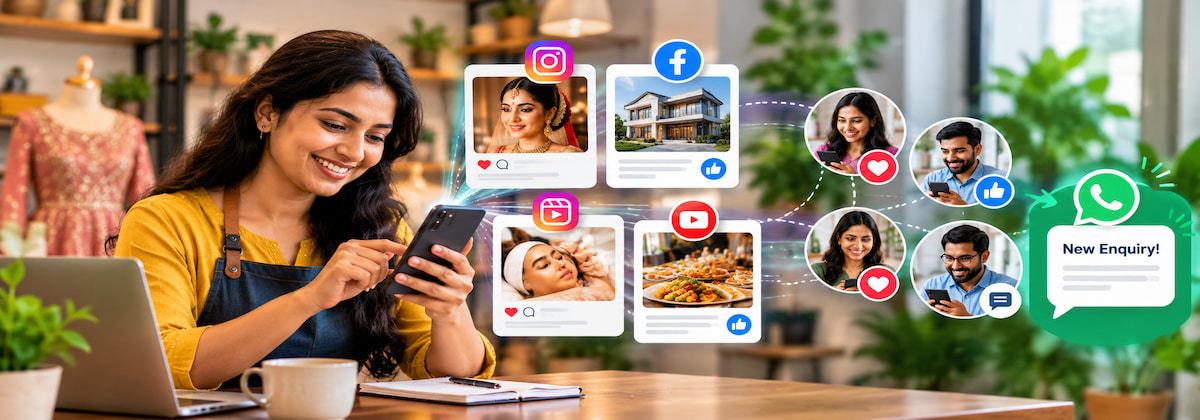
How Can Social Media Marketing Help a Small Business?
These benefits don't happen just because you have a Facebook or Instagram account. They happen when the platform, content, audience and business goal work together. Here are eight practical ways social media marketing can support a small business.
1. It helps more people discover your business
A potential customer may not know your business today. But when they see your Reel, post, demonstration or customer story, your business becomes visible to them.
This works especially well for businesses that depend on visuals:
- A bridal makeup artist can show transformations and completed work
- A real estate agent can showcase properties
- A skincare clinic can explain common skin concerns
- A kids' academy can show activities and learning
- A financial consultant can explain complicated topics in simple language
Visibility should also be relevant. Reaching random people is not the same as reaching people who may actually need your product or service. That is where marketing begins.
2. It helps build trust and credibility
Before contacting you, people often visit your profile. What they see can shape their opinion of your business: your work, services, customer experiences, demonstrations and useful information.
This is very important for service businesses, because customers cannot always judge a service before buying it. Good content reduces that uncertainty.
This is also why I don't look at followers only as a number. A follower may not be your customer today, but may become one when the need arises. And when someone visits your profile, a consistent presence and a healthy follower base add to the trust they feel.
3. It lets you show what you actually offer
Saying "We provide bridal makeup" is very different from showing the transformation, the process and a happy customer's experience. Social media lets you demonstrate instead of just telling.
One caution: don't put everything into one creative. If one image is full of text and tries to explain your whole business, it becomes hard to read and unattractive. Give each post one clear purpose.
4. It helps you start conversations with potential customers
Social media is not just a publishing platform. It is also a communication channel. Think about your own behaviour when you see content:
- Like: the content appealed to you
- Comment: you have a question or doubt
- Share: you found it useful for someone else
- Follow: you expect future content to be relevant
- Enquiry: you are ready to start a business conversation
That is how your customers behave too. So don't judge every post only by its likes. Ask: what did this content help the customer understand, feel or do?
5. It can turn attention into business enquiries
Most business owners want results, such as WhatsApp messages, phone calls, appointment requests, product enquiries or lead forms. A simple customer journey looks like this:
Content → Interest → Profile → WhatsApp / Website → Enquiry → Follow-up → Sale

Social media plays an important role in the first stages. But a post does not bring an enquiry just because it is published. It must reach the right audience, say something relevant and give a clear next step.
6. It can bring people to your website or WhatsApp
Social media doesn't have to complete the whole journey. It can introduce your business and then move people to another channel:
- Instagram → WhatsApp
- Facebook → Website
- Instagram → Landing Page → Enquiry
Think about the complete enquiry path, not only individual posts. People may also find your website through Google search, which is where SEO helps. You can read more in What Is SEO? A Simple Guide for Business Owners.
7. Paid ads help you reach a more specific audience
Organic content shows you what your audience responds to. Paid ads then help you reach a more targeted audience. But ads are not simply "put money in and get leads". You need to think about who you want to reach, what message you are showing, which audience responds, what each enquiry costs and what to improve.
A lesson from a skincare clinic in Coimbatore
A skincare clinic contacted me because they were not getting proper enquiries from social media. They ran WhatsApp lead ads with a daily budget of about ₹200–₹250. But whenever they spent ₹50–₹60 without an enquiry, they switched the ad off, and restarted it the next day. Their conclusion: ads don't work.
I explained that switching an ad off after such a small spend doesn't give enough data to judge it. A new ad needs a few days to learn and gather data. In this case, we let it run for about 10 days and then optimised: which platform, age group and gender responded better. Once they stopped switching it off and started optimising, the cost per enquiry came down gradually, from roughly ₹80 in the first days to around ₹38–₹40 later. Eventually she was getting more enquiries than she could handle on her own, without a telecalling team.
The lesson: don't judge an ad after a very small spend. Give it enough time, then optimise. (Results vary by business, audience and offer.)
8. It helps you understand what your customers want
Social media also gives you customer insight. Look at what people ask in comments and messages, what they share, save, respond to and ignore. If people keep asking the same question, that question becomes your next piece of content. This creates a useful cycle:
Create → Publish → Observe → Learn → Improve → Create again
Why Do Some Businesses Post Regularly but Still Get No Enquiries?
The issue is usually not the number of posts. It is the quality, relevance and purpose of the content. These are the most common problems:
- Too much text: all the information is crammed into one image
- No clear hook: the viewer has no reason to stop and look
- Weak visuals: useful information, but not attractive
- No call to action: the viewer doesn't know what to do next
- Generic content: not made for a specific group of customers
- No marketing objective: posting just to stay active
A good creative doesn't have to explain everything. It has to make the right person stop, understand the main message and take the next step.
Is Free Posting the Same as Social Media Marketing?
No. This is one of the biggest differences I see among business owners. Many start because the platforms are free. They post whatever content they have and try to get as much free reach as possible.
There is nothing wrong with using free features. The problem starts when a business expects free posting alone to bring predictable results. Marketing means asking:
- Who is my customer?
- What problem do they have?
- What offer is relevant to them?
- Where can I reach them?
- What should they do after seeing my content?
The goal is to reach the right audience, at the right time, with the right offer.
Which Social Media Platform Should a Small Business Use?
You don't need to be on every platform. The right choice depends on:
- Your target customer and where they spend time
- The type of content you can create well
- Whether your business is visual
- Whether your goal is awareness, enquiries or sales
- How much time you can realistically give
In my experience, Instagram works best when your customers are mostly in the 18–35 age group. But it needs stronger visuals, videos and Reels to get visibility, engagement and conversions. Facebook reaches all age groups and has less visual pressure. Choose based on your audience, not because everyone else is using it.
What Is the Difference Between Organic Social Media and Paid Ads?
Organic social media is free, but the platform decides who sees your post. Paid ads cost money, but you have much more control over who you want to reach.
Organic social media
- What it is: posting on your Facebook and Instagram pages and sharing in groups.
- Cost: free.
- Reach: depends on the platform's algorithm.
- Control: you cannot choose who sees your post.
Paid ads (Meta Ads)
- Cost: you pay Meta to show your ad.
- Audience: you choose who you want to reach.
- Location: you choose the exact area.
- Platforms and placements: you choose where the ad appears, for example Facebook or Instagram, and in the feed, stories or Reels.
- Control: you set who you want to reach, so your money goes to the people who are most likely to need you.
For many businesses, using both organic content and paid ads over time works better. Test with organic content first, then use ads to reach more people. And don't run only lead ads. Brand awareness and engagement ads also matter, because, in my experience, when people already know your brand, the cost and quality of your enquiries usually improve.
Meta ad objectives: what each one does
Meta has six ad objectives. Choose the one that matches what you want the ad to do.
- Awareness: show your brand to more people, so they start to recognise it.
- Traffic: send people to your website or landing page.
- Engagement: get people to react, comment or message you.
- Leads: bring enquiries, for example WhatsApp messages.
- Sales: bring purchases, for businesses that sell online.
- App promotion: bring app installs, only if you have an app.
Meta also has a simple Boost option, which promotes a post you have already published. It is quick to start, but it is not an objective and it gives you fewer options than Ads Manager.
Start with a small budget and give the ad a few days to learn. After about 10 days, compare which platform, age group and gender respond better, and keep improving. Track what each enquiry costs and how good the enquiries are, not only likes and views.
How Do You Start Social Media Marketing? (Step-by-Step Guide)
- Understand your product or service. Be clear about what you are offering.
- Identify your customers. Who are they, what are they looking for, and what problems do they have?
- Understand their expectations. What do they want to achieve, and what information helps them decide?
- Make a simple content plan. Ask ChatGPT or Gemini for a 7-day or 10-day content calendar based on your customer, their problems and your offer.
- Design content with a hook and a call to action. One clear message per post.
- Test different formats. Try different visuals, hooks, topics and messages.
- Observe, track and improve. See which content gets better response, and track enquiries, not just likes and views.
- Then add paid ads. Use what you learned to run awareness, engagement and lead ads, and optimise them using the results.
Why Does Social Media Marketing Need Consistency?
One of the biggest challenges I see while coaching business owners is consistency. They start with enthusiasm, run an ad, wait for enquiries, and if results don't come quickly, they stop. Later they start again.
But social media marketing is not a one-time effort. Your audience needs repeated exposure to your business. Your content needs continuous improvement. Your ads need monitoring and optimisation.
Also, not every activity needs to bring a lead immediately. Someone may see your business today, follow you, and contact you months later when they actually need your service. Awareness, engagement and trust all support your enquiries.
Final Thoughts: Don't Sell. Solve the Customer's Problem.
Social media is a great opportunity for small businesses. But free platforms don't mean free results.
If I could give one piece of advice to a business owner, it would be this: don't just sell your product or service. Understand your customer's problem or pain, and show how your product can reduce or solve it. Build your content around that.
Instead of asking "What should I post today?", ask: "What does my customer need to know, and how can my business help?"
If you want to learn how to apply this to your own business through one-to-one practical coaching, explore the Social Media Marketing Coaching program from Digital Success Tamil.
Learn more: