If you have a business website, simply having the website is not enough. Your potential customers need to be able to find your business when they search Google for the products or services you offer.
SEO, or Search Engine Optimization, is the process of improving your website and online presence so that your business has a better opportunity to appear prominently in relevant Google search results.
For a business owner, SEO is not a one-time activity. It is an ongoing process involving your website, keywords, content, technical foundation, local visibility and continuous improvement.
After more than seven years of training and coaching business owners, including 2,000+ business owners I have guided, I have noticed that many business owners misunderstand SEO in very similar ways.
They often expect SEO to work like an advertisement: spend money today, get enquiries tomorrow, and finish the process after a few weeks. That is not how SEO works.
Let's look at what business owners should actually understand about SEO.
What Is SEO and How Does It Actually Work?
SEO stands for Search Engine Optimization.
When someone searches Google for a product, service or answer, Google has to determine which results are most relevant and useful for that particular search.
For example, someone might search for:
- Digital marketing coach in Chennai
- Bridal makeup artist near me
- Interior designer in Chennai
- Website designer for small business
- SEO consultant for small business
If your business provides one of these services, you want your website or relevant online presence to be visible when potential customers make those searches.
SEO is the process of improving your online presence so search engines can better understand:
- What your business does
- What products or services you provide
- Which topics your website covers
- Who your services are for
- Which locations you serve
But SEO is not about simply putting keywords on a website. It involves website structure, relevant content, search intent, technical SEO, local SEO and ongoing improvement.
The goal is to make your website useful and understandable to both your potential customers and search engines.
Why Does Appearing on the First Page of Google Matter?
When people search Google, they usually want to find a relevant answer or solution quickly.
If your business does not appear prominently for searches that are important to your business, potential customers may never discover your website through those searches. That is why business owners are interested in first-page visibility.
For example, imagine you provide website design services. A potential customer searches:
"Website designer for small business in Chennai"
If your website appears prominently among the relevant results, that person has an opportunity to visit your website, understand your service and contact you. If your website is nowhere near the relevant results, that opportunity is much smaller.
However, it is important not to think of SEO as simply: "Get to position number one at any cost."
Search visibility is useful only when it brings the right visitors. Your content must satisfy the searcher's intent, and your website must give those visitors a good experience once they arrive. Google itself emphasizes helpful, people-first content rather than content created primarily to manipulate rankings.
What Are the Three Main Types of SEO?
SEO is usually divided into three areas.
1. Technical SEO
This is the technical foundation of your website. It helps search engines crawl, understand and index your pages. Examples include website speed, mobile-friendliness, HTTPS, crawlability, indexing and structured data.
2. On-Page SEO
This is optimizing the content and elements of each page so that search engines and visitors understand the topic. It includes page titles, headings, content, keywords, images, internal links and meta descriptions.
3. Off-Page SEO
These are activities outside your website that build its authority and reputation. The most important example is earning relevant, high-quality backlinks. Mentions and references from other websites also help.
These three areas work together. Technical SEO helps search engines access your website. On-page SEO helps them understand each page. Off-page SEO helps build trust and authority.
What Is the Practical SEO Framework?
From my experience of coaching business owners, this is how the three types of SEO work together during the life of a website.
Stage 1: While the website is being built
Technical SEO + On-Page SEO
Technical SEO is the foundation of the website, and on-page SEO is planned along with it. Both should be considered together while designing the website.
Stage 2: After the website is launched
On-Page SEO continues + Off-Page SEO begins
Now you optimize and improve the pages, add useful content, and start building visibility and authority through backlinks and mentions.
Stage 3: Ongoing
Technical SEO monitoring + On-Page improvements + Off-Page activities
SEO does not finish after launch. All three areas continue.
What each area does:
- Technical SEO = Foundation. It needs regular monitoring and audits. Check for speed changes and crawling errors. For a small business website, a monthly check is a practical routine, and you should also check after any major website change.
- On-Page SEO = Optimize & Improve. This is continuous improvement and content updates.
- Off-Page SEO = Build Visibility & Authority. This is an ongoing visibility and authority building activity.
What Is the First Step in SEO?
Now that you know the three types of SEO and how they work together, where should you actually begin?
Before choosing keywords or writing content, first check whether your website is actually ready for SEO.
This is something I regularly explain to business owners. When someone tells me "I want to start SEO for my business," I don't think the first question should always be "Which keywords should we target?"
The first question should be: "What does your current website look like?"
If your website has very little useful information, poor structure, unclear services or technical problems, SEO becomes much more difficult to implement effectively.
SEO should therefore be considered as part of the website strategy — not something that is simply added after the website has already been built.
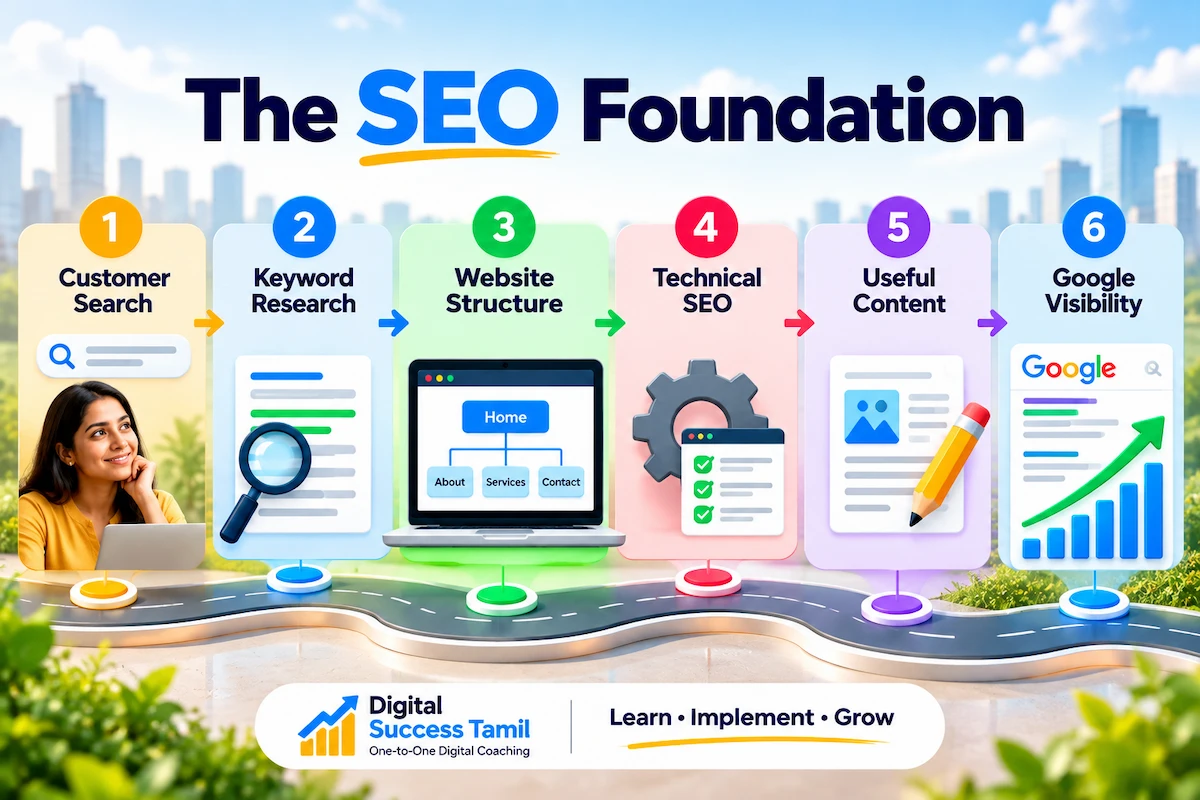
What Kind of Website Do You Need Before Starting SEO?
This is one of the biggest misunderstandings I have noticed while coaching business owners.
Many business owners think a "proper website" simply means: company name, company photographs, product photographs, about information, phone number, address. They may therefore choose a very low-cost website based mainly on price — sometimes a single page containing all the information.
A simple one-page website can be suitable for certain purposes. But if your goal is to build search visibility around multiple services, products, topics or customer questions, you need to think differently.
For example, a business may benefit from separate, useful pages for: Home, About, Individual services, Products, Service areas, FAQs, Contact, Educational content.
The exact structure depends on the business. More pages do not automatically mean better SEO. Each page should have a genuine purpose and provide useful information. The advantage of having appropriate dedicated pages is that you can clearly explain different services, products and topics instead of trying to put everything onto one page.
A common pattern I see: after coaching more than 2,000 business owners, I have noticed that many initially choose a website based mainly on cost. Later, when they decide to invest in SEO, they discover that the website was not planned for search visibility or future content expansion. Then changing the website becomes difficult.
The business owner may say: "I already paid for my website. Why should I change it?" The answer is that the website may have been designed simply to exist online, while the business now wants it to attract relevant search visitors and generate enquiries. Those are not always the same requirement.
That is why I recommend thinking about SEO requirements when planning the website, rather than treating SEO as something to add at the end.
What Should You Research Before Writing Website Content?
You should understand what your potential customers actually search for.
This is where keyword research becomes important. Business owners often write website content based entirely on what they want to say about their business. But customers may use completely different words when searching Google.
Keyword research helps you understand what people search for, how they describe your products or services, which search terms are relevant to your business, what questions they ask, and what type of information they are looking for.
The goal is not to collect hundreds of keywords. The goal is to understand customer search behaviour and search intent. Once you understand that, you can plan the right pages and content.
Why Is Good Content Important for SEO?
Good content helps both your potential customers and search engines understand what your business offers.
A useful service page should not simply say "We provide professional digital marketing services." It should explain what the service is, who it is for, what is included, what problem it solves, what customers should consider, what questions customers commonly have, and what the next step is.
The same principle applies to blog articles. Don't write an article simply because a keyword tool suggested a keyword. Write it because your potential customers genuinely need the information.
Why Does Technical SEO Matter?
Now that you understand the three areas of SEO and how they work together, let's look more closely at technical SEO, because it forms the foundation of your website. Content is only one part of SEO. Your website also needs a reasonable technical foundation.
Technical SEO can include areas such as crawlability, indexing, mobile usability, website structure, page performance, HTTPS and structured data where appropriate.
You don't need to become a technical SEO expert to understand the basics. But technical problems can make it harder for search engines to access and understand your website. User experience matters as well — mobile usability, secure delivery, and whether visitors can easily access the main content all factor in.
So SEO is not simply "Add keywords → rank on Google." It is a combination of content, website structure, technical foundation, relevance and user experience.
Is SEO a One-Time Expense or an Ongoing Process?
SEO is an ongoing process, not a one-time expense. As the practical framework showed, technical monitoring, on-page improvements and off-page work all continue after launch.
This is one of the most common misunderstandings I come across when coaching business owners. Some think: "I will invest in SEO for a few months, get my website to the first page, and then the work is finished." But achieving visibility is not the end of SEO.
Search results can change. Competitors can improve their websites. Customer search behaviour can change. Your own products and services can change. Google also continuously improves and updates its search systems.
Think about it this way. You don't open a physical shop, arrange everything once and then never maintain it again. The same principle applies to your online presence. Getting visibility is one stage. Maintaining and improving it is an ongoing process.
How Long Does SEO Take to Show Results?
SEO does not normally produce instant results.
This is another area where business owners sometimes have unrealistic expectations. If you make changes to your website today, you cannot expect Google to immediately move your pages to the top of the search results.
Google needs to discover and process your pages, and many factors influence how relevant and useful a page may be for a particular search. The timeline can vary depending on:
- Competition
- Search demand
- Website condition
- Existing authority
- Content quality
- Technical issues
- Target search terms
- Location
- Consistency of implementation
So be careful when someone promises: "We will put your website on the first page within 15 days." There is no responsible way to guarantee a specific Google ranking on a fixed timeline.
One thing I often notice while coaching business owners: those with experience running Facebook Ads or Google Ads sometimes expect SEO to behave in the same way. With advertising, you can start a campaign and potentially receive visibility and enquiries relatively quickly. SEO is different — it takes time to build organic visibility. This difference in speed is one of the reasons some business owners stop SEO too early.
What Is Local SEO and Why Does It Matter to Local Businesses?
If your business serves a specific city or geographical area, local SEO can be particularly important.
For example, a Chennai business may want to appear when potential customers search for relevant services in Chennai or nearby areas.
Local SEO can involve your Google Business Profile, business information, website service pages, location information, customer reviews, local relevance, and local content.
But local SEO does not mean adding "Chennai" repeatedly to every paragraph. Location information should be used naturally and accurately. Your website and Google Business Profile should clearly communicate: what you do + who you serve + where you serve them.
What Is the Difference Between SEO and Google Ads?
This is one of the most common questions business owners ask.
The simplest explanation is: Google Ads provides paid visibility. SEO focuses on organic search visibility.
Google Ads can start generating visibility much faster because you are paying to participate in the advertising system. SEO generally takes longer because you are building organic visibility over time.
Google Ads: You run the campaign → your eligible ads can appear → you pay according to the campaign model → when the campaign stops, that paid visibility stops.
SEO: You improve the website → create useful content → address technical issues → build relevance → monitor performance → continue improving.
Neither approach automatically replaces the other. Depending on the business, SEO and Google Ads can work together.
There is another important connection: both SEO and Google Ads ultimately send people to your website or landing page. So if your website is confusing, slow, poorly structured or does not clearly explain your service, simply increasing traffic does not solve the underlying problem. A strong website foundation therefore supports your wider digital marketing efforts.
Why Can Google Search Traffic Be Valuable for a Business?
I often explain this to business owners using a simple idea: Google is a demand-fulfillment platform.
Consider the difference between these two situations. Someone is scrolling through Facebook and sees an advertisement for a website design service — they may or may not need the service. Now consider someone who searches "Website designer for small business in Chennai." That person has already expressed a need. They are actively looking for a solution.
That is why search traffic can be valuable. When your business appears for a relevant search, the visitor may already have an interest in your product or service. They may then: Search → Visit your website → Understand your offer → Enquire → Potentially become a customer.
Of course, SEO does not guarantee conversion. The website, offer, credibility, pricing and enquiry process all influence what happens after the visitor arrives. SEO creates the opportunity to be discovered. Your business then needs to convert that opportunity.
What Have I Observed While Teaching Business Owners About SEO?
After more than seven years of training and coaching business owners, I have noticed a few recurring patterns.
- Many business owners think SEO is a one-time expense. They expect to invest for a short period, achieve a ranking and stop.
- Many choose their website mainly based on price. Later, when they want to invest in SEO, they discover that the website needs better structure or more useful content.
- Many compare SEO with advertising. They are used to seeing relatively quick results from paid campaigns, so they become impatient when SEO takes longer.
- Some stop SEO too early. They may work with one agency for a short period, stop, then start again with another provider later. In that process, they can spend money repeatedly without giving one consistent strategy enough time and continuity.
This is why I believe business owners need to understand the SEO process before investing heavily in it. You don't need to become an SEO expert. But you should understand what is being done, why it is being done and what realistic progress looks like.
What SEO Mistakes Do Business Owners Commonly Make?
Mistake 1: Writing only for Google. Content filled with keywords but lacking useful information does not help the reader. Write for people first.
Mistake 2: Repeating the same keyword everywhere. Using the same phrase unnaturally in every heading and paragraph does not make content better. Use natural language and relevant variations.
Mistake 3: Choosing a website based only on price. A cheap website may appear affordable initially, but rebuilding or restructuring it later can create additional cost and effort.
Mistake 4: Ignoring local SEO. If your business depends on customers from a particular location, don't ignore your Google Business Profile and local online presence.
Mistake 5: Publishing random content. Ten random articles are not necessarily better than three genuinely useful articles that answer important customer questions.
Mistake 6: Expecting immediate SEO results. SEO is not the same as paid advertising. Give the process realistic time and evaluate the work being done.
Mistake 7: Focusing only on rankings. A ranking is not the final business objective. The real objective is to attract relevant visitors and turn appropriate visitors into enquiries or customers.
SEO Checklist: What Should a Business Owner Do Before Starting SEO?
If you are considering SEO for your business, start with these questions:
- Is my website ready? Can it clearly explain your business, products and services?
- Do I know what my customers search for? Don't assume your customers use the same words you use.
- Does each important service have enough useful information? If you offer several important services, consider whether visitors need dedicated pages to understand each one properly.
- Is the website technically sound? Check important technical, mobile and performance issues.
- Is my content based on customer needs? Create content that answers genuine customer questions.
- Have I considered local SEO? If your business serves a specific location, make sure your website and Google Business Profile communicate that clearly.
- Am I prepared for ongoing SEO? Don't start SEO with the expectation that the work will be finished after one month.
- Do I understand what my SEO provider is doing? You don't have to become an SEO expert, but you should understand the strategy and the work being carried out.
When Should a Business Owner Get Help With SEO?
You can learn many SEO fundamentals yourself. However, professional guidance may be useful when:
- You don't know why your website isn't getting organic traffic
- You aren't sure which search terms to target
- Your website has technical problems
- Your industry is competitive
- You don't have time to manage SEO consistently
- You want a structured SEO and content strategy
- You want to understand SEO and implement it yourself with guidance
If you are looking for SEO coaching, the important thing is to understand what you are actually learning or investing in. Ask: What will be done? Why is it being done? Which pages are being improved? How will progress be measured? What should I realistically expect?
Avoid treating SEO as a promise of a guaranteed Google ranking.
Final Thoughts: What Should You Remember About SEO?
If you remember only a few things from this article, remember these:
- SEO is not a one-time expense.
- SEO does not produce instant results.
- Your website foundation matters.
- Keyword research should come before creating SEO-focused content.
- Useful content matters more than simply repeating keywords.
- Technical SEO and user experience matter.
- Local businesses should consider local SEO.
- SEO and Google Ads are different, but they can support each other.
- SEO has three parts: technical SEO (foundation), on-page SEO (optimize and improve) and off-page SEO (visibility and authority).
And most importantly: Don't think of SEO as paying someone to "get your website on Google." Think of it as continuously improving your online presence so that the right people can discover your business when they search for what you offer.
From my experience of training and coaching business owners, the biggest improvement often starts with a change in mindset. Instead of asking "How quickly can I get my website to the first page?" ask "What does my potential customer search for, and is my website genuinely the best place for them to find the answer?"
That is a much better starting point for SEO.
Learn more: About Senthil Kumar · Web Designing Course · SEO & Google Ads Course · How Social Media Marketing Can Help Grow Your Business